
Seoul, 9–13 September 2026
Churches and ecumenical partners from around the world gathered in Seoul from 9 to 13 September 2026 for the International Ecumenical Peace Convocation. Convened by the World Council of Churches (WCC), the Christian Conference of Asia (CCA), and the National Council of Churches in Korea (NCCK), the Convocation marked the 40th anniversary of the 1986 Glion meeting and brought together church leaders, ecumenical bodies, academics, and young people to reflect on the churches’ calling to build just peace on the Korean Peninsula and beyond.
The anniversary carries deep meaning for the ecumenical movement. In 1986, in Glion, Switzerland, Christians from the North and the South of the Korean Peninsula met face to face for the first time since the division, in a gathering facilitated by WCC. That meeting became a milestone in a long journey of prayer, dialogue, and solidarity for peace and reconciliation in Korea, a journey that churches in Korea and around the world have continued to walk for four decades. Returning to Seoul forty years later, participants looked back with gratitude on that legacy while asking honestly what faithfulness to peace requires in today’s world, marked by militarisation, deepening polarisation, and conflicts in many regions.
The central outcome of the gathering was the 2026 International Ecumenical Peace Declaration, “Affirmation of Just Peace”, adopted by participants on 11 September and formally handed to NCCK on 13 September. The Declaration was prepared by a drafting committee of seven members, led by WCC and including NCCP, the Presbyterian Church (USA), the Evangelical Church in Baden, Chung-Ang University, NCCK, and WSCF Asia-Pacific, represented by Regional Executive Yowanda Yonggara. Through this work, WSCF Asia-Pacific helped ensure that the Declaration recognises the place of women and young people in the churches’ pursuit of peace, and calls for young people to share in decision-making within churches and ecumenical bodies.
At the heart of the Declaration is the conviction that peace is more than the absence of war. Just peace, as understood in the ecumenical movement, is rooted in justice, dignity, and right relationships among people, communities, and creation. It asks churches not only to pray for peace, but to confront the structures that keep people divided, to accompany those who suffer the cost of conflict, and to make room for those whose voices have long been missing from the conversation.
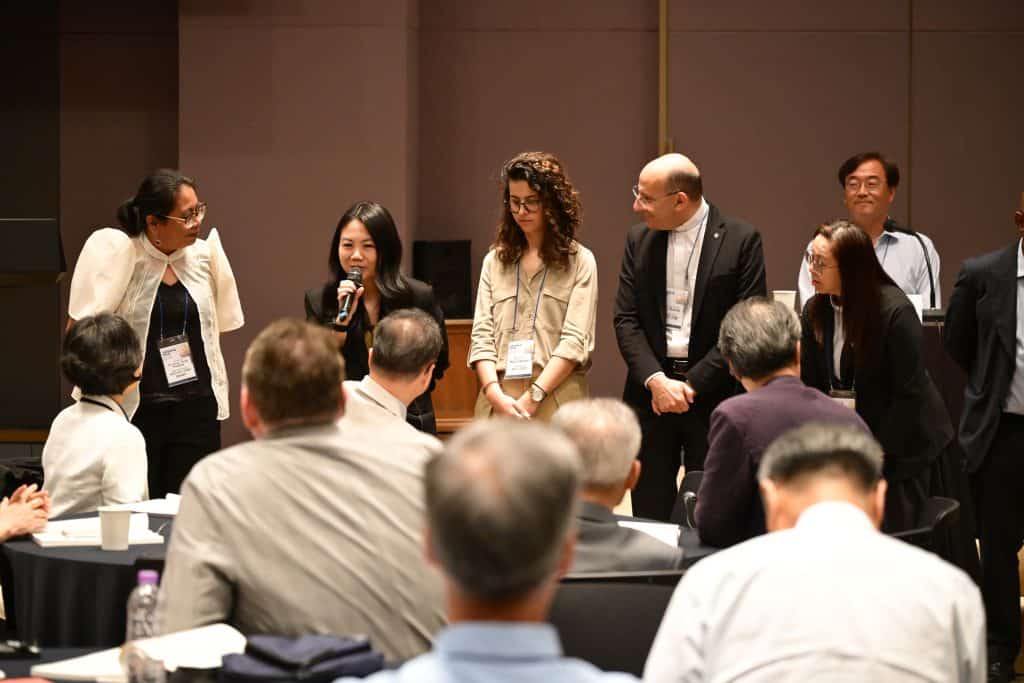
Over five days, participants took part in plenaries, workshops, and public witness. On 10 September, Yowanda Yonggara spoke in the workshop “Youth’s Role in Peacebuilding” alongside Abigayle Bolado of the WCC Youth Desk and Kim Jin Su, General Secretary of the Ecumenical Youth Council in Korea (EYCK). The workshop explored how young people are not only future leaders but present actors in peacebuilding, carrying fresh imagination, courage, and networks across borders that the wider church can learn from. The Convocation also held a press conference and a DMZ Peace Pilgrimage, where participants prayed and walked together near the line that divides the Korean Peninsula, a powerful reminder that division is not only a political reality but a wound carried by families and communities.
For WSCF Asia-Pacific, the Convocation was also a moment to connect the global ecumenical agenda with the life of student movements in the region. Many Student Christian Movements across Asia and the Pacific live in contexts shaped by conflict, displacement, and unresolved histories of division. The conversations in Seoul resonate with the Federation’s ongoing peace witness, including the global WSCF Peace Campaign “Reclaiming Otherness,” launched in September 2026, which invites students to encounter the “other” not as a threat but as a neighbour.
The Convocation reminded the ecumenical movement that just peace cannot be built without those who have too often been left out of the room. WSCF Asia-Pacific remains committed to ensuring that young people are not only invited to speak of peace, but share in the power to make it.