
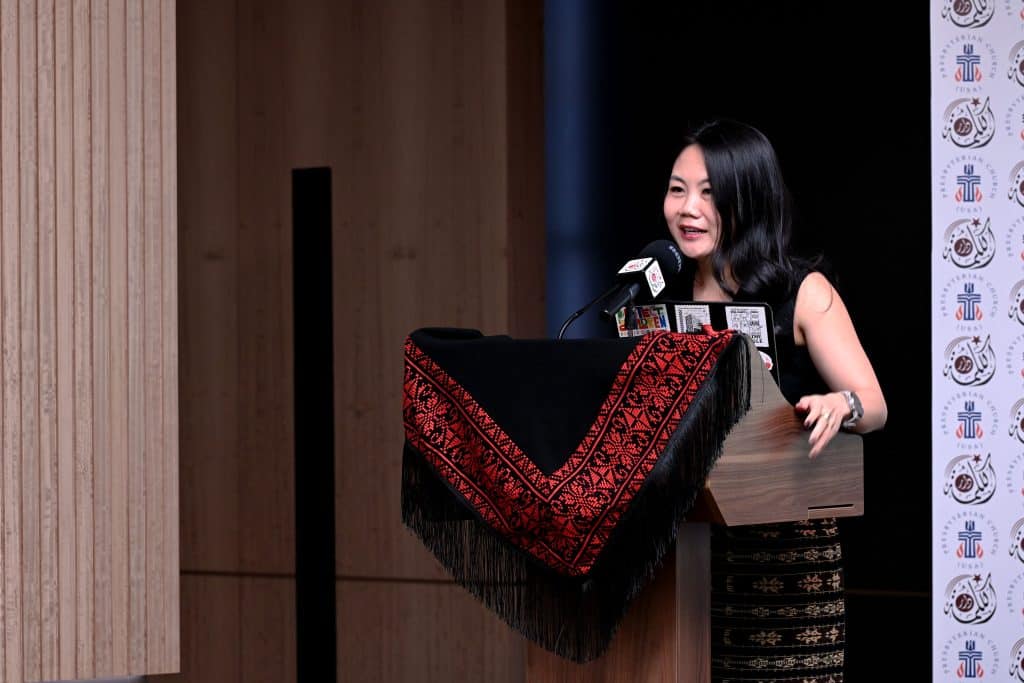
From 1 to 6 September 2026, 66 theologians, church leaders, seminary presidents, students, scholars, and activists from 34 countries across Asia, Africa, the Middle East, Europe, and North America gathered in Istanbul, Türkiye, for the conference Christianity without Zionism: Mapping and Combating Christian Zionism in Asia and Africa. The conference was designed as an intergenerational and intersectional space, with strong participation of young people and women.
The conference was convened by the Presbyterian Church (U.S.A.) and Dar al-Kalima University in Bethlehem, Palestine, in partnership with the All Africa Conference of Churches, the Council for World Mission, the World Communion of Reformed Churches, and the World Student Christian Federation (WSCF). It continued a series of consultations held in Chile (2022), Jordan and Denmark (2025), and Norway and the United States (2026).
Yowanda Yonggara, Regional Executive of WSCF Asia-Pacific and the Federation’s Global Program Director for Democracy, Human Rights and Fundamentalisms, attended the conference and represented WSCF.
Why the conference met
Participants gathered while the genocide in Gaza continued, as named in the conference communiqué. The conference set out to map the growth of Christian Zionism in Asia and Africa, to analyse the theological narratives that sustain it, and to develop resources that help churches resist imperial readings of scripture.
The conference heard Christian Zionism described not simply as a mistaken reading of the Bible, but as a Christian lobby supporting the settler colonisation of Palestine, one in which scripture is treated as a title deed, election as ethnic privilege, and land as possession. Participants examined the larger narratives that feed it in different countries, including Christian nationalism, the prosperity gospel, and Islamophobia, as well as the role of pilgrimage tourism, media, and publishing in spreading it. Speakers also observed that Christian Zionism cannot be understood apart from wider systems of militarism, empire, ethnonationalism, and geopolitical power.
Speakers from Asia and Africa acknowledged that their own churches are not bystanders, and that many are implicated financially, theologically, and emotionally. Palestinian Christians present reminded the conference that its work must remain accountable to those living under occupation and dispossession, and that they speak as people of the land, not as a subject of study.
Throughout the conference, participants condemned white supremacy and all forms of racism, including antisemitism and Islamophobia, and affirmed the distinction between Judaism and Zionism, and between the Jewish people and the policies of a state.
WSCF’s contribution: formation and the voice of the young
On 5 September, Yowanda Yonggara spoke on the closing panel, The Way Forward, chaired by Rev. Prof. Mitri Raheb. She opened by asking everyone in the room who had once been part of a Student Christian Movement to raise their hand, and many did. Her point was that much of the ecumenical commitment to justice in Palestine was first formed in student movements.
She recalled that the Federation’s position on Palestine has been shaped by young people themselves, including a proposal brought by a Palestinian student from the Palestine Youth Ecumenical Movement and adopted at WSCF’s 37th General Assembly in 2022. She also urged that solidarity with Palestine be taught alongside the struggles students already know in their own contexts, rather than as a distant cause, and that this solidarity must run both ways. “We do not add a cause. We connect a wound,” she said.
Speaking to how theology spreads today, especially through online preaching and social media, she noted: “You cannot out-argue a formation. You can only out-form it.” She shared WSCF’s commitments to integrate the theology of land and the question of Palestine into its formation work, beginning with the School for Ecumenical Leadership Formation (SELF) 2026: to support the Federation’s developing global programme on “come and see” pilgrimage to Palestine; and to propose a youth-oriented information hub on Palestine, built together with Palestinians, in the languages students actually speak.
A call to action
The conference closed with the Istanbul Communiqué, issued on 5 September 2026. Among its calls, it urges churches to confront the misuse of Christian theology to justify militarism, occupation, and dispossession, calls on churches in Asia and Africa to bring the story of Palestine into the formation of their members and young people, including in digital spaces; asks theological institutions to distinguish between biblical Israel and the modern state in their teaching: encourages churches to respond to the Palestinian invitation to “come and see” calls on ecumenical bodies to carry into their own processes; and calls on governments to uphold international law. Participants committed to continuing as a network in support of the Palestinian people.